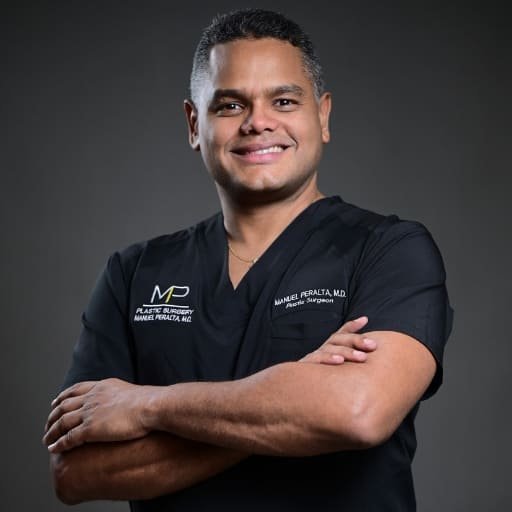
DR. MANUEL PERALTA
PLASTIC SURGEON

Breast Augmentation Recovery Dominican Republic — What Your Body Is Telling You at Every Stage
Every patient wants to know the same thing after breast augmentation:
“When will I feel normal again?”
The answer is more individual than a calendar suggests.
Breast Augmentation Recovery depends on factors such as the surgical technique, implant characteristics, implant placement, the patient’s anatomy, overall health and how the body responds to surgery.
Some patients feel significantly better within several days. Others need more time before the pressure, tightness, swelling and fatigue begin to settle.
That difference does not necessarily mean something is wrong.
Recovery should be understood as a progression rather than a deadline.
During breast augmentation recovery, your body is simultaneously healing the incisions, adapting the soft tissues to the implant, resolving postoperative inflammation and allowing the breast to gradually assume its new position.
This is why the question should not only be:
“How many days until I recover?”
A better question is:
“What should I expect my body to be doing at this stage, and what would be unusual?”
This guide explains Breast Augmentation Recovery through that lens, focusing not only on how long healing takes, but on what patients can expect at each stage.
It covers what patients commonly experience, what activities should be introduced gradually, why swelling and breast position change over time, how exercise and sleep fit into recovery, how international patients should plan their return home, and which symptoms deserve prompt medical attention.
Important: Your surgeon’s postoperative instructions take priority over general information on this page because your recovery plan should reflect your specific procedure and medical circumstances.
THE SHORT ANSWER: HOW LONG DOES BREAST AUGMENTATION RECOVERY TAKE?
There is no single recovery timeline that applies to every patient. Understanding Breast Augmentation Recovery is therefore more useful when the process is divided into stages rather than reduced to one fixed number of days.
The American Society of Plastic Surgeons notes that recovery varies according to factors including the procedure, implant placement and individual healing. Many patients experience substantial improvement within the first week, while full recovery may take several weeks.
For practical planning, it is more useful to think about recovery in stages:
First 24–72 hours: protection, rest, pain control and early movement.
Days 4–7: symptoms often begin to become more manageable, although swelling and tightness remain common.
Weeks 2–3: daily activities progressively become easier, but the breasts are still healing.
Weeks 4–6: many patients progressively return to more normal physical activity when cleared by their surgeon.
Beyond six weeks: healing continues even when the patient feels recovered, and the final appearance may continue to evolve.
These are planning ranges, not medical deadlines. For patients planning Breast Augmentation Recovery in the Dominican Republic, these stages can also help with scheduling postoperative appointments, assistance, work and travel.
ASPS reports that full recovery commonly takes approximately four to six weeks, while other ASPS guidance emphasizes that the timeline can vary considerably between patients.
THE MOST IMPORTANT IDEA: FEELING BETTER DOES NOT MEAN YOU ARE FULLY HEALED
One of the easiest mistakes during Breast Augmentation Recovery is confusing symptom improvement with complete tissue healing.
You may feel substantially better before your tissues have finished repairing themselves.
This distinction matters because pain often decreases before the body has regained its full tolerance for lifting, repetitive upper-body movement, vigorous exercise or other physical stress.
A patient may therefore feel capable of doing something before the tissues are ready for it.
That is why postoperative restrictions exist.
Feeling good is encouraging. It is not automatically permission to resume every activity.
BREAST AUGMENTATION RECOVERY: WHAT HAPPENS TO YOUR BODY?
After surgery, the body enters a normal healing response.
Several processes occur simultaneously:
Inflammation: The tissues respond to surgical trauma, producing swelling and temporary sensitivity.
Incision healing: The skin and underlying tissues begin repairing themselves.
Tissue adaptation: The breast envelope adjusts to the implant and the new volume.
Muscle adaptation: When an implant is placed beneath or partially beneath the pectoral muscle, the muscle and surrounding tissues may contribute to postoperative tightness and discomfort.
Fluid redistribution: Swelling gradually decreases as healing progresses.
Implant settling: The breast may initially appear higher, firmer or different from the eventual result.
This is why the appearance during the first days should not be interpreted as the final result. Understanding this process is an important part of Breast Augmentation Recovery because early swelling and tissue tension can temporarily change the appearance of the breasts.
THE FIRST 24 HOURS: PROTECTION BEFORE PROGRESS
The first day is not about seeing the final result.
It is about safely transitioning from surgery to recovery. During this early stage of Breast Augmentation Recovery, protection and appropriate postoperative care are more important than trying to resume a normal routine.
Patients may experience:
- soreness
- chest pressure or tightness
- swelling
- bruising
- fatigue
- temporary changes in breast or nipple sensation
- effects from anesthesia
- difficulty using the upper body normally
ASPS notes that acute pain commonly decreases during the first several days, while soreness and swelling can continue for weeks.
You should expect your surgeon to provide specific instructions regarding medications, wound care, support garments, bathing and activity.
Do not substitute a generic internet protocol for those instructions.
During the first day, walking may be encouraged according to your surgeon’s instructions. Prolonged complete bed rest is generally not the objective after uncomplicated surgery; early gentle movement may be part of postoperative care.
DAYS 2–3: YOUR BODY IS STILL IN THE EARLY HEALING PHASE
The second and third days can be psychologically difficult because patients sometimes expect rapid improvement.
The breasts may still feel:
- swollen
- firm
- tight
- sensitive
- heavy
- asymmetrical
- higher than expected
These findings can occur during normal healing. This stage of Breast Augmentation Recovery can feel very different from what patients expected, particularly when swelling and tightness temporarily affect the shape of the breasts.
The important question is not whether your breasts look exactly as you imagined.
The important question is whether your symptoms are following the expected postoperative pattern and whether you have any warning signs.
Continue following your surgeon’s medication, wound-care and activity instructions.
Gentle walking may be encouraged, but strenuous exercise, heavy lifting and movements that place excessive stress on the chest should be avoided until your surgeon allows them.
DAYS 4–7: THE FIRST MAJOR TURNING POINT
For many patients, the first week marks a noticeable change in comfort.
ASPS reports that some patients can return to desk work within several days, while other patients may need approximately a week or longer depending on the procedure, occupation and individual recovery.
This does not mean that the breast tissue is fully healed.
You may still experience:
- swelling
- firmness
- tightness
- bruising
- altered sensation
- fatigue
- limited upper-body movement
A common mistake is to interpret improvement as permission to accelerate activity.
Instead, the first week of Breast Augmentation Recovery should be viewed as the transition from surgical recovery to controlled rehabilitation of normal activity.
WEEK 2: WHEN LIFE STARTS FEELING MORE NORMAL
By the second week, many patients notice substantial improvement.
Normal daily movement becomes easier.
Work may be possible depending on the occupation and the surgeon’s assessment.
Walking can usually become more comfortable.
However, the breasts are still changing.
Swelling may remain.
The implants may still appear higher than expected.
One breast may appear different from the other.
The skin may feel tight.
Sensation may still be different.
None of these findings should automatically be interpreted as the final outcome. For many patients, this is the stage of Breast Augmentation Recovery when daily life becomes easier, even though the breasts are still changing.
ASPS guidance emphasizes that strenuous activity should be resumed according to the surgeon’s instructions rather than according to an arbitrary calendar.
WEEKS 3–4: RECOVERY BECOMES LESS ABOUT PAIN AND MORE ABOUT PATIENCE
By this stage of Breast Augmentation Recovery, many patients are thinking less about surgery and more about getting back to their normal lifestyle.
This is where another important distinction appears:
Less pain does not necessarily mean complete recovery.
The tissues are still remodeling.
The scars are still maturing.
The breasts may continue changing in softness and position.
Exercise may be progressively reintroduced according to the surgeon’s instructions. ASPS sources commonly describe gradual progression during this period, with more strenuous activity generally delayed until the surgeon considers healing adequate.
WEEKS 4–6: RETURNING TO MORE NORMAL ACTIVITY
For many patients, weeks four through six represent a major milestone. This stage of Breast Augmentation Recovery is often when patients begin to feel substantially closer to their normal routine, although healing is still continuing.
The breasts often feel more familiar.
Swelling has generally decreased substantially.
Daily activities become easier.
Physical activity may progressively increase if the surgeon confirms that healing is progressing appropriately.
However, the exact timing depends on:
- implant placement
- surgical technique
- individual healing
- complications, if any
- type of exercise
- occupation
- surgeon-specific postoperative protocol
There is no universal “day 42” when every patient becomes fully recovered.
That is why postoperative clearance should come from the surgeon rather than from an online calendar.
WHY YOUR BREASTS MAY LOOK “TOO HIGH” AFTER SURGERY
This is one of the most common concerns after breast augmentation.
Patients sometimes look in the mirror during the first days and think:
“They don’t look like the breasts I expected.”
Early postoperative breasts may appear:
- high
- firm
- swollen
- tight
- less mobile
- different from each other
This can reflect postoperative swelling and tissue tension.
The appearance continues to evolve as healing progresses.
The early postoperative appearance should therefore not be confused with the mature result.
Your breasts are healing before they are finished settling into their final appearance.
WHY ONE BREAST MAY HEAL DIFFERENTLY FROM THE OTHER
Perfect symmetry before surgery is uncommon.
The two sides can differ in:
- breast volume
- chest wall anatomy
- nipple position
- skin elasticity
- tissue thickness
- muscle anatomy
- pre-existing asymmetry
After surgery, those differences can become temporarily more noticeable.
One side may swell more.
One implant may appear higher.
One breast may feel tighter.
This does not automatically mean that the implant has been misplaced or that the final result will remain asymmetric.
However, a new or rapidly worsening asymmetry should be discussed with the surgeon.
PAIN VS. PRESSURE VS. WARNING SIGN
A useful way to understand Breast Augmentation Recovery is to distinguish expected discomfort from symptoms that require medical assessment.
Normal postoperative discomfort may include soreness, tightness, swelling and sensitivity that gradually improve.
A concerning pattern is different.
Contact your surgical team promptly if you experience symptoms such as:
- rapidly increasing swelling
- significant new asymmetry
- increasing redness
- drainage from the incision
- fever
- worsening pain rather than gradual improvement
- shortness of breath
- chest pain
- significant leg swelling or pain
- other symptoms that your surgical team instructed you to report urgently
FDA patient information specifically advises contacting the surgeon when fever, noticeable swelling, redness or drainage occurs in an implanted breast.
Do not diagnose a complication from an online article. Contact your medical team.
WHEN CAN I RETURN TO WORK AFTER BREAST AUGMENTATION?
There is no single answer because “work” can mean very different physical demands.
A desk-based job may allow an earlier return than work involving:
- lifting
- pushing
- pulling
- repetitive arm movement
- physical care of other people
- manual labor
Some ASPS guidance reports that certain patients may return to desk work within several days, while others recommend planning approximately one week or longer depending on the procedure and occupation.
The better question is:
What does your job require from your chest, shoulders and arms?
That answer is more clinically useful than simply asking how many days have passed.
WHEN CAN I EXERCISE AFTER BREAST AUGMENTATION?
Exercise should return progressively.
Walking is often introduced early.
More demanding activity should wait until your surgeon clears it.
The type of exercise matters.
Running, jumping, chest exercises, heavy lifting and activities involving substantial upper-body movement may place different stresses on healing tissues.
ASPS guidance commonly recommends avoiding strenuous activity during the early recovery period and progressively returning to exercise after appropriate healing.
The objective is not to return to the gym as quickly as possible. The objective is to return without compromising healing.
WHEN CAN I DRIVE AFTER BREAST AUGMENTATION?
Driving requires more than simply being able to sit in a vehicle.
You need to be able to:
- react quickly
- turn the steering wheel safely
- perform emergency maneuvers
- wear a seat belt comfortably
- control the vehicle without significant pain
- avoid medications that impair alertness
Your surgeon should determine when you can safely resume driving based on your recovery and medications.
Do not drive while taking medications that impair your ability to operate a vehicle.
WHEN CAN I SLEEP ON MY SIDE AFTER BREAST AUGMENTATION?
Sleep position is one of the most common practical questions after surgery.
Your surgeon may initially recommend sleeping on your back and may provide specific positioning instructions based on your procedure.
The exact timing for returning to side sleeping varies.
Do not assume that because a certain position feels comfortable, the tissues are automatically ready for it.
Follow the postoperative positioning instructions provided by your surgeon.
WHEN CAN I LIFT MY CHILD AFTER BREAST AUGMENTATION?
This is particularly important for mothers.
A child is not simply “weight.”
Lifting also involves:
- reaching
- pulling
- stabilizing
- carrying
- sudden movements
These actions can place stress on the chest and upper body.
If you have young children, arrange assistance during the early recovery period.
Your surgeon should determine when lifting is safe based on your procedure and healing.
BREAST AUGMENTATION RECOVERY AND SEXUAL ACTIVITY
Sexual activity can increase heart rate, blood pressure and physical movement.
The timing for resuming sexual activity varies according to the procedure and healing.
The key consideration is avoiding pressure, impact or movements that could stress the breasts during the early recovery period.
Ask your surgeon for individualized clearance rather than relying on a generic number of days.
WHEN DO BREAST IMPLANTS START TO SETTLE?
Patients often use the expression “the implants need to drop.”
Medically, what patients are observing is a combination of postoperative swelling, tissue adaptation, implant position and gradual changes in the breast envelope.
The process is not identical in every patient.
Implant placement, anatomy, tissue characteristics and surgical technique influence how the breasts look during recovery.
Therefore:
Do not judge the final result from the first postoperative photographs.
WHEN WILL MY BREAST AUGMENTATION LOOK NATURAL?
A natural appearance is not achieved on a particular day.
The breasts may initially look swollen or unusually firm.
As swelling decreases and the tissues adapt, the appearance can become softer and more integrated with the patient’s anatomy.
The final appearance depends on factors including:
- implant dimensions
- implant profile
- implant placement
- breast tissue
- skin envelope
- chest wall anatomy
- preoperative breast position
- healing
This is one reason implant selection and recovery cannot be considered separate subjects.
SCARS DURING BREAST AUGMENTATION RECOVERY
Every surgical incision creates a scar.
During the early stages, scars may appear:
- pink
- red
- raised
- firm
- darker than surrounding skin
Scar maturation takes considerably longer than the first few weeks of recovery.
Your surgeon may recommend specific incision care, silicone products or other scar-management strategies depending on your case.
Do not apply products to an incision unless your surgical team has approved them.
BREAST AUGMENTATION RECOVERY FOR INTERNATIONAL PATIENTS
For an international patient, Breast Augmentation Recovery planning begins before the flight home.
The surgery is only one part of the medical journey.
You also need to consider:
How long will I remain near my surgeon?
Who will help me during the first days?
Where will my postoperative evaluations occur?
What happens if I develop a problem after returning home?
These questions are particularly important because follow-up becomes more complicated once the patient crosses an international border. A well planned Breast Augmentation Recovery can therefore include postoperative evaluation, assistance during the first days and enough time in the Dominican Republic before returning home.
ASPS warns that medical tourism can create challenges related to follow up and treatment of complications after patients return home.
WHEN CAN I FLY AFTER BREAST AUGMENTATION?
Do not plan your return flight simply around the cheapest ticket.
Air travel after surgery is one of the practical considerations that should be addressed as part of Breast Augmentation Recovery planning.
ASPS has advised waiting at least five to seven days after breast augmentation before flying, while CDC guidance notes that travel during postoperative recovery can add thromboembolic risk and provides more conservative guidance for some chest or abdominal procedures.
Your actual travel date should therefore be determined by:
- the procedure performed
- your recovery
- your surgeon’s assessment
- your individual risk factors
- the length of the flight
- whether complications have occurred
For international patients, the safest itinerary is the one that leaves enough time for appropriate postoperative assessment—not simply the one that minimizes hotel nights.
THE RECOVERY PLAN SHOULD BE DESIGNED BEFORE SURGERY
A smoother recovery is easier when the patient prepares in advance.
Before surgery, plan:
Transportation: Someone should be available to assist you after anesthesia.
Medication: Know what has been prescribed and how your surgeon wants it used.
Sleeping arrangement: Prepare a comfortable environment that allows the recommended position.
Food and hydration: Have appropriate meals and fluids available.
Clothing: Front-opening garments can make dressing easier during the early period.
Childcare: Arrange help if you care for young children.
Work: Plan adequate time away from physically demanding activities.
Travel: International patients should plan postoperative appointments and the return journey around medical clearance.
WHAT NOT TO DO DURING BREAST AUGMENTATION RECOVERY
Do not accelerate your recovery because you feel better.
Do not increase exercise suddenly.
Do not lift heavy objects simply because the pain has disappeared.
Do not massage your breasts unless your surgeon specifically recommends it.
Do not change medications without medical advice.
Do not ignore rapidly worsening swelling or redness.
Do not compare your recovery day by day with another patient’s recovery. Every Breast Augmentation Recovery follows an individual pattern, even when two patients undergo similar procedures.
And do not assume that a social-media recovery timeline applies to your surgery.
Your operation was performed on your anatomy, not someone else’s. Your recovery belongs to your body.
THE “GREEN, YELLOW, RED” RECOVERY MODEL
A useful way to understand Breast Augmentation Recovery is to classify what you are experiencing into expected progression, situations that require contact with your surgical team, and symptoms that require urgent medical assessment.
GREEN EXPECTETED PROGRESSION
Examples may include:
- gradual reduction in discomfort
- decreasing swelling
- temporary tightness
- bruising that progressively fades
- changing breast position
- temporary sensory changes
- increasing ability to perform daily activities
These findings should still be interpreted within your surgeon’s postoperative instructions.
YELLOW — CONTACT YOUR SURGICAL TEAM
Examples include:
- symptoms that are not improving as expected
- increasing rather than decreasing pain
- new asymmetry
- persistent concerns about an incision
- unexpected changes in swelling
- questions about medication or activity
The correct response is not to diagnose yourself. Contact the team that performed your surgery.
RED — SEEK URGENT MEDICAL ASSESSMENT
Symptoms such as:
- chest pain
- significant difficulty breathing
- fainting
- severe or rapidly worsening symptoms
- significant leg swelling or pain
- signs of serious infection
require prompt medical assessment.
THE MOST IMPORTANT RECOVERY MILESTONES
Instead of memorizing a rigid calendar, remember these milestones:
Milestone 1 — Safe transition home
You are stable after anesthesia and have appropriate assistance.
Milestone 2 — Pain becomes manageable
Acute discomfort begins to decrease.
Milestone 3 — Daily independence returns
Basic activities become easier.
Milestone 4 — Work becomes possible
Depending on occupation and recovery.
Milestone 5 — Exercise returns progressively
Only after appropriate clearance.
Milestone 6 — Swelling continues to resolve
The breasts gradually become softer and more integrated.
Milestone 7 — Long-term result becomes clearer
The mature appearance develops over time rather than immediately after surgery.
BREAST AUGMENTATION RECOVERY IS ALSO ABOUT FOLLOW-UP
Recovery does not end when the patient stops taking pain medication. Follow up is therefore an essential part of Breast Augmentation Recovery, rather than an optional step after the patient begins feeling better.
Follow-up allows the surgical team to evaluate:
- incision healing
- swelling
- breast position
- asymmetry
- implant position
- signs of infection
- sensory changes
- overall progress
FDA materials emphasize the importance of postoperative follow-up and ongoing monitoring for patients with breast implants.
For patients traveling internationally, follow-up planning becomes even more important.
WHAT IF MY RECOVERY DOES NOT LOOK LIKE SOMEONE ELSE'S?
That is normal.
Two patients can undergo breast augmentation on the same day and have different:
- pain levels
- swelling
- bruising
- breast position
- sensory changes
- return-to-work dates
- exercise progression
- implant settling patterns
The objective of Breast Augmentation Recovery is not to make every patient follow the same calendar.
It is to determine whether your individual recovery is progressing appropriately.
BREAST AUGMENTATION RECOVERY: THE QUESTIONS PATIENTS SHOULD ASK BEFORE SURGERY
Understanding Breast Augmentation Recovery before surgery allows patients to plan their work, exercise, childcare, transportation, follow up and travel more realistically.
Before surgery, ask your surgeon:
- What recovery timeline is realistic for my specific procedure?
- Where will my implants be placed?
- How might placement affect my recovery?
- When can I return to desk work?
- When can I return to physically demanding work?
- When can I drive?
- When can I exercise?
- When can I sleep on my side?
- When can I lift my children?
- When can I fly home?
- What symptoms should make me contact the surgical team?
- Who will provide follow-up if I am an international patient?
- How long should I remain near the surgical facility?
- What happens if a complication occurs after I return home?
These questions transform recovery from an assumption into a plan.
Frequently Asked Questions About Breast Augmentation Recovery Dominican Republic
How long does breast augmentation recovery take?
Breast Augmentation Recovery varies between patients. Most patients improve substantially during the first week, but complete recovery commonly takes several weeks. ASPS sources describe an average full recovery of approximately four to six weeks, although individual recovery varies.
What is the most painful day after breast augmentation?
There is no universal “most painful day.” Many patients report the greatest discomfort during the first several days, particularly when implants are placed beneath the pectoral muscle. The important pattern is that discomfort should generally become more manageable rather than progressively worsen
How long will my breasts stay swollen?
Swelling commonly persists for several weeks and gradually decreases. The exact duration varies according to the procedure and individual healing.
When can I return to work after breast augmentation?
Some patients with desk jobs return within several days, while others need approximately a week or longer. Physically demanding work generally requires a longer restriction period. Your surgeon should determine your specific timeline.
When can I exercise after breast augmentation?
Exercise should be resumed gradually and according to your surgeon’s instructions. Walking is commonly introduced early, while strenuous exercise and significant upper-body activity generally require additional healing time.
When can I drive after breast augmentation?
You should be able to control the vehicle safely, react normally, wear a seat belt comfortably and avoid medications that impair alertness. Your surgeon should clear you to drive based on your recovery.
When can I sleep on my side?
Your surgeon may initially recommend sleeping on your back. The timing for returning to side sleeping varies according to the procedure and individual healing.
Why do my implants look high after surgery?
Early swelling, tissue tension and the initial position of the breast can make implants appear higher or firmer than expected. The breasts may change progressively as swelling decreases and the tissues adapt.
When will my breasts look natural after augmentation?
The appearance evolves as swelling decreases and tissues adapt. The final appearance should not be judged during the first postoperative days.
When should I call my surgeon after breast augmentation?
Contact your surgical team if you develop increasing pain, significant new swelling, redness, drainage, fever, rapidly developing asymmetry or another symptom that concerns you. Emergency symptoms such as significant difficulty breathing or chest pain require urgent medical evaluation.
Is it normal for one breast to be more swollen than the other?
Some asymmetry can occur during healing, particularly because the two sides may have different anatomy and respond differently to surgery. New or rapidly worsening asymmetry should be evaluated by your surgical team.
Can breast augmentation recovery be faster?
Breast Augmentation Recovery should not be treated as a race. Appropriate surgical planning, following postoperative instructions, gradual activity progression and attending follow-up appointments can support safe healing. There is no safe universal shortcut.
BREAST AUGMENTATION RECOVERY IN THE DOMINICAN REPUBLIC
For international patients, choosing where to have surgery is only the first decision.
The recovery plan is equally important. For international patients, Breast Augmentation Recovery in the Dominican Republic should be planned around both medical follow up and the practical realities of remaining away from home.
A responsible medical-tourism plan should answer:
Where will I stay after surgery?
When will my first postoperative assessment occur?
How long will I remain in the Dominican Republic?
Who will assist me during the first days?
When will my surgeon clear me to fly?
What documentation should I take home?
Who should I contact if a concern develops after returning home?
These questions should be answered before surgery rather than after the plane ticket has already been purchased.
For patients considering breast augmentation with Dr. Manuel Peralta in Santo Domingo, recovery planning should be discussed during the consultation and individualized according to the procedure performed.
RELATED PATIENT RESOURCES
Dr. Manuel Peralta — Board-Certified Plastic Surgeon in Dominican Republic
Learn about the surgeon, training and approach to patient care.
Breast Augmentation Dominican Republic
Learn how anatomy, implant dimensions, tissue characteristics and aesthetic goals influence breast augmentation planning.
Breast Implants Dominican Republic
Understand implant size, profile, shape, material, placement and long-term considerations.
Breast Augmentation Safety Dominican Republic
Explore surgical safety, patient selection, risk management and postoperative monitoring.
Begin Your Transformation with Dr. Manuel Peralta
Your Recovery Should Have a Plan Before Your Surgery
Breast augmentation is not finished when the procedure ends.
The weeks that follow are part of the treatment.
Knowing what to expect can reduce unnecessary anxiety, help you recognize changes that deserve attention and make it easier to return to normal activity at the appropriate pace.
If you are considering breast augmentation in Santo Domingo, discuss not only the implant and the aesthetic goal, but also your Breast Augmentation Recovery plan.
Ask what your body will need after surgery not only what your breasts will look like.
Schedule a consultation with Dr. Manuel Peralta
Medical Information & Patient Disclaimer
This page is provided for educational purposes and is not a substitute for an in person medical consultation, diagnosis or individualized postoperative instructions.
Breast augmentation recovery varies between patients and depends on factors including surgical technique, implant placement, implant characteristics, anatomy, health status and individual healing.
The postoperative instructions provided by your plastic surgeon should always take priority over general information published online.
If you have undergone surgery and develop concerning or worsening symptoms, contact your surgical team or seek appropriate medical evaluation.
Get a free consultation